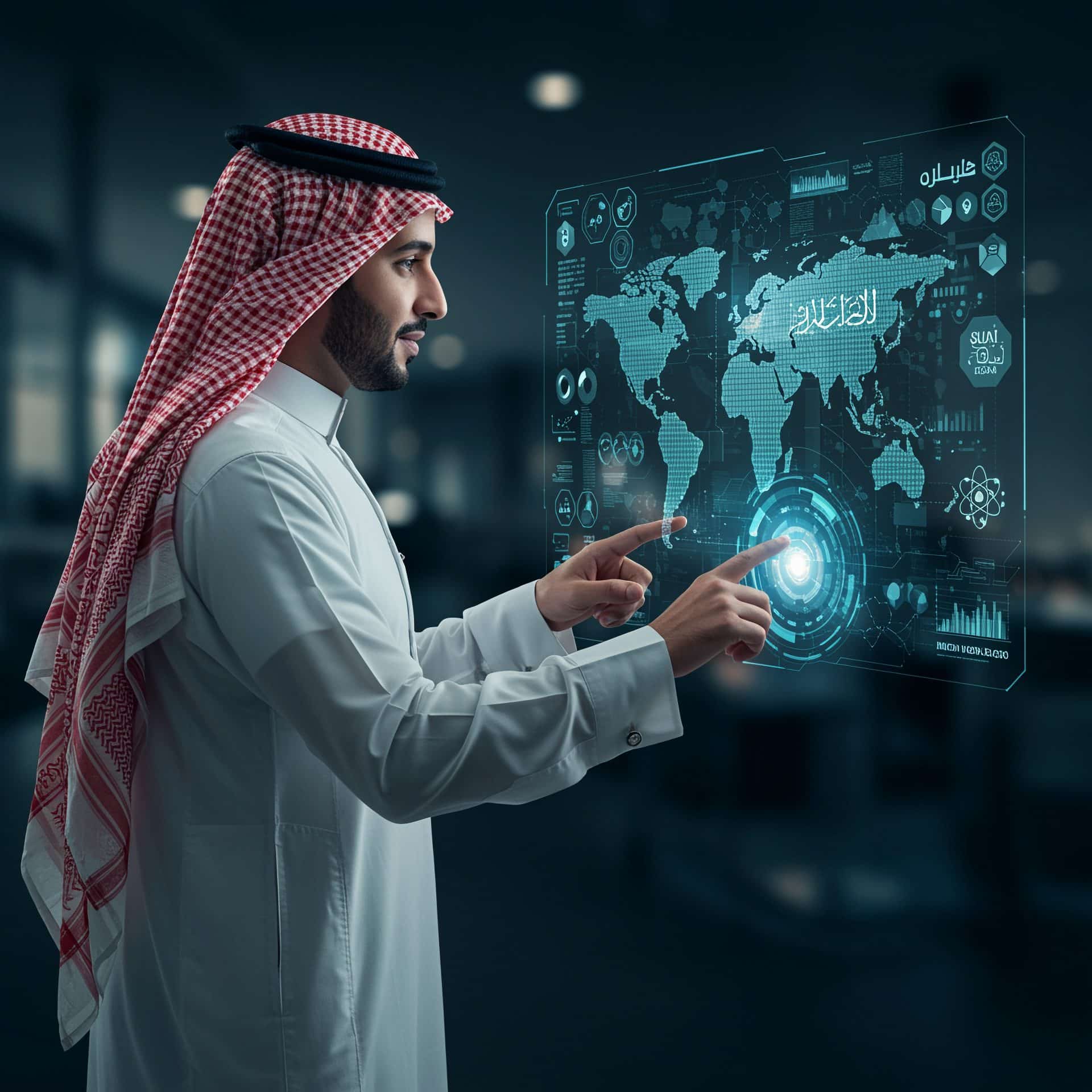
Despite a disruptive and unpredictable year, Saudi Arabia is keeping its eye on the ball when it comes to a central pillar of its economic development strategy: AI.
Earlier this year, national leaders declared 2026 the Year of Artificial Intelligence as plans and partnerships with some of the world's biggest multinational corporations move forward. Most of the coverage has focused on what's being built. But for international businesses eyeing the MENA region, the more consequential story is what all of that infrastructure will run on: language. Arabic is being built into the foundations of the technologies that will mediate search, commerce, and customer service across the region — which makes high-quality Arabic localization less of a marketing decision and more of a market-entry requirement. For companies looking to break in, qualified partners like e-Arabization are ready to accelerate go-to-market strategies and remove friction points with deep linguistic and cultural expertise.
The scale is worth stating quickly. More than $100 billion has gone into AI development to date, with international investment still pouring in as leaders work toward the goals of Vision 2030. Between its central position between three continents, its extremely cheap electricity, and a headstart on data centers, the country is already positioned to become an AI superpower — and ranked 14th in the 2025 Global AI Index on the way there.
Digital ecosystems properly supported by AI infrastructure are projected to be vital for the future of international business. The runway, in other words, is being built. What travels down it is content — and content is a language problem.
Arabic's presence in the digital space has long been limited by a variety of factors, including its semantics and its many dialects. The written material AI systems learn from skews heavily toward formal Arabic — the language of news and official communication. It is not the language anyone uses to search for a product, complain about a delayed order, or talk to a support agent. That happens in Gulf, Levantine, Egyptian, or Maghrebi Arabic, and the gap between the two is where most localization failures live.
The stakes of that gap are real. Being caught on the wrong end of the digital divide carries serious implications: speakers have access to fewer goods, services, and economic opportunities, while the language itself suffers growing irrelevance. Saudi Arabia's emphasis on AI is a move toward closing it — and as more digitized Arabic content proliferates, more companies see the value of localizing their own content into the language.
Better Arabic models lower the cost of operating in the language. What they don't do is make the judgment calls. A model can produce ten plausible Arabic versions of a marketing line. It can't reliably tell you which one lands in Riyadh but reads strangely in Casablanca, which carries an unintended connotation, or which register signals respect rather than distance to an enterprise buyer.
Those failures are rarely obvious mistranslations. They're tonal misjudgments and cultural missteps — expensive to detect, slow to repair, and damaging to trust. Modern linguists like those at e-Arabization are already adept at harnessing AI's full power for clients precisely because they know where it needs a human alongside it.
There's a second implication worth planning for. As Arabic AI becomes the layer through which customers find products and get answers, your content stops being read only by people and starts being read by machines on their behalf.
That rewards consistency: one agreed term per concept, clear structure, and a translation memory that keeps a product name or legal disclaimer identical everywhere it appears. Machine-translated Arabic published at volume does the opposite — it fills the ecosystem with unreliable text, and that text is what the systems your customers query will learn from.
For companies considering expansion across Saudi Arabia and the wider MENA region, the opportunity is significant—but Arabic-speaking markets are neither linguistically nor culturally uniform. Success requires more than translating content at scale; it requires the right language, register, terminology, and cultural judgment for each audience. As AI becomes increasingly embedded in how people search, shop, and access services, companies that build high-quality Arabic content now will be better positioned to earn trust and grow across the region.