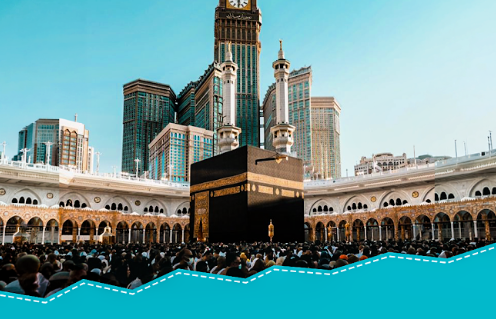
Over the past several years, religious and government officials in Saudi Arabia have introduced digital tools to help pilgrims of all tongues and nationalities navigate Hajj, the pilgrimage that most Muslims complete at least once in their lifetime. But that doesn’t mean good, old-fashioned, human-powered translation and interpretation don’t serve their role, either.
Arab News reports that young Saudi volunteers provide essential services in assisting pilgrims who can’t find help in their own language, become lost, or otherwise need assistance. The translators and interpreters are also essential in helping pilgrims with special needs, like the disabled and elderly.
“I initially joined a team for emergency medical services,” translator Deema Ibrahim told Arab News. “But when we arrived, we found that the ambulance units were already full. So we were redirected to work in the road guidance division.”
“I also assisted deaf and mute pilgrims through remote video calls,” she added. “That allowed me to support a wider group of people who would otherwise be left struggling.”
It’s a uniquely human touch these volunteers provide, one that is undoubtedly well-received when religious connection and spiritual growth are the priority. Volunteer translators and interpreters do everything from guiding pilgrims to managing logistics to assisting individual crises, like when Ibrahim returned a lost, elderly woman to her family.
“We eventually found a card with her camp name, called them, and her daughters came running,” she told Arab News. “They didn’t expect to find her again. It was a moment I’ll never forget.”
But for a religious pillar as massive as Hajj, which sees an average of 2.3 million pilgrims arrive in Mecca each year, human translators aren’t enough to facilitate everything. And Saudi officials are deploying increasingly sophisticated tools and techniques to provide a safe and edifying pilgrimage regardless of native language.
For instance, Mint reports that in 2025, the Arafat sermon, delivered at Mount Arafat where the Prophet Mohammed delivered his last sermon, was translated and broadcasted live into 35 languages. It was a technological feat enabled through AI that meant both those present and those listening from around the world heard the sermon in their own language.
“[It demonstrates] how technology and tradition can harmonise to elevate spiritual experience,” the Saudi Ministry for Haj and Umrah said in a statement regarding the achievement. “Translation is not simply a technical feature — it is a spiritual bridge.”
Indeed, AI is increasingly seen as the tool of choice to unify pilgrims across languages. Asia News Network reports that simultaneous live translation is just one resource in the toolbox for deepening the Hajj experience. The Nusuk app provides a multilingual platform to organize, plan, register, and navigate the Hajj journey and includes an AI personal assistant for translation and pilgrim assistance. And field teams equipped with AI communication devices are able to deliver aid and advice to pilgrims regardless of their native language.
“By placing real-time translation at the core of the Hajj experience, Saudi Arabia is creating a global case study for how technology can enhance, not replace, faith,” the Saudi Ministry for Haj and Umrah said in a press release. “What was once a logistical challenge is now an opportunity to deepen spiritual connection. In bridging languages, the kingdom is also bridging hearts. Through thoughtful innovation, Hajj is not only more accessible, but it’s more connected, more human, and more spiritually alive than ever before.”